
You don't have to develop everyone in your organization to create an impact that reaches beyond the room.
I've had a complicated relationship with the word scalable for years.
And it's taken me a while to appreciate that reaching more people and making a bigger impact aren't necessarily the same thing.
Earlier in my career, I worked under a director who was determined to make our services more scalable. It wasn't a particularly healthy leadership environment, and I struggled with the assumption that serving more people automatically meant we were doing better work.
We were in a human-centered service industry, where a relatively small proportion of our clients needed specialized support. I believed strongly that those who needed our help deserved individualized attention and personal connection, not a standardized, one-size-fits-all approach.
To me, those relationships weren't an inefficiency to be eliminated. They were an essential part of what made the work valuable.
That experience stuck with me. And I've had to challenge my own knee-jerk reaction to the word scalable ever since.
Because I've come to appreciate an important distinction:
Scaling a service isn't necessarily the same as scaling its impact.
When Reaching Everyone Becomes a Barrier
Today, in my work with leadership teams and organizations, I see a different side of the scalability conversation.
HR and talent development leaders are often trying to accomplish a great deal with limited resources. They recognize the value of investing in stronger communication, more effective leadership, and healthier team dynamics.
But they also have competing priorities, tight budgets, and plenty of employees who could benefit from development.
And that creates a difficult question:
How do we justify investing in professional development for just one or two teams when so many others could benefit?
It's a reasonable concern. No one wants to make an investment that feels too limited to create meaningful organizational change.
But I wonder whether our focus on reaching everyone sometimes keeps us from making a difference anywhere.
We can become so concerned with finding a solution that serves the entire organization that we overlook opportunities to make a smaller, more strategic investment.
And sometimes, that's exactly where meaningful change begins.
The Difference Between Scaling Reach and Scaling Impact
When we talk about scalability, we often think about delivering a consistent experience to a larger audience.
That approach has its place. Organization-wide programs can establish shared language, communicate expectations, and make learning accessible to a broad group of employees.
But when the goal is to improve how people lead, communicate, and work together, the number of participants isn't necessarily the best measure of success.
Consider a leadership team that develops a better understanding of individual communication preferences.
The immediate benefit might be more productive meetings, clearer expectations, and fewer misunderstandings within that team.
But those leaders don't operate in isolation.
They carry that awareness into conversations with their direct reports. They become more intentional about how they communicate decisions, provide feedback, and navigate differences.
And the people they work with experience those changes, even if they never attended the original development session.
Or consider a department that's struggling with conflict and collaboration.
A focused team development experience might help its members recognize unproductive patterns, better understand one another's perspectives, and establish practical agreements about how they'll work together.
As those practices become part of their everyday interactions, they can also influence relationships with other departments.
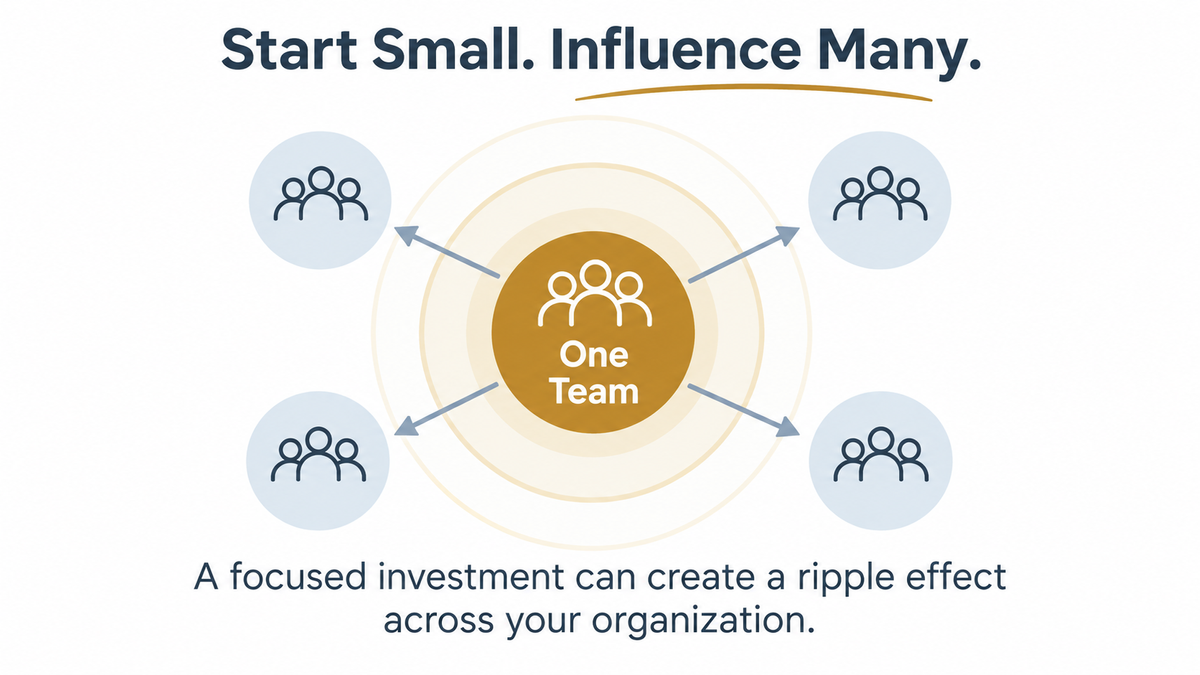
The learning doesn't have to stay with the people in the room.
It can ripple outward through the relationships, decisions, and interactions that connect an organization.
Of course, those ripple effects aren't guaranteed. People need opportunities to practice what they've learned, and organizations need to reinforce the changes they want to see.
But when development is thoughtfully designed and intentionally applied, its influence can extend well beyond the original participants.
Why Starting Small Can Be a Strategic Choice
One of the things I value most about boutique consulting is the opportunity to understand what makes a particular team or organization unique.
At Horizon Team Design, I often begin by working closely with just one or two teams.
We explore their specific challenges, how they communicate, where collaboration breaks down, and what might help them work more effectively together.
The goal isn't simply to deliver a workshop. It's to help people develop insights and practical approaches they can carry into their everyday work.
And when we think strategically about where to begin, that focused investment can have broader implications.
For example, an organization might start with:
A senior leadership team whose communication and decision-making influence multiple departments.
A cross-functional team whose ability to collaborate affects projects throughout the organization.
A management team whose leadership practices shape the experiences of dozens or hundreds of employees.
A department navigating significant change whose success could provide useful lessons for other teams facing similar challenges.
Each offers an opportunity to create meaningful improvement within a smaller group while extending the potential benefits beyond it.
The important question isn't necessarily how many people participate.
It's where development has the greatest potential to make a difference.
Making the Ripple Effect Intentional
I love the image of learning rippling outward from a small group. But there's an important distinction between hoping that happens and designing an experience that encourages it.
If broader organizational impact is the goal, we need to think beyond the workshop itself.
What will participants do differently afterward?
How will those changes show up in their relationships with colleagues, direct reports, and other teams?
What opportunities will they have to practice and reinforce what they've learned?
And how will we recognize whether the development is making a difference?
These questions help connect individual and team learning to broader organizational goals.
A leadership team might commit to specific communication practices that improve clarity across departments. A management group might establish shared approaches to feedback or conflict. A cross-functional team might develop collaboration agreements that can be adapted elsewhere.
The goal isn't to replicate the same experience for everyone.
It's to help useful practices take hold and spread.
And that, to me, is a much more interesting way to think about scalability.
A Different Way to Think About Your Development Investment
I still believe there's an important place for broad-reaching talent development programs. Some organizational goals genuinely call for consistent learning experiences across large groups.
But not every challenge requires an organization-wide initiative.
And not every meaningful investment needs to begin with one.
If you're considering leadership or team development but the cost, time, or logistics of reaching everyone feel overwhelming, I'd encourage you to consider a different starting point.
Ask yourself:
Which team has the greatest opportunity to positively influence others?
Where would stronger communication, healthier collaboration, or more effective leadership make a noticeable difference?
What might change if that team had the opportunity to develop together, apply what they've learned, and carry those practices into the rest of the organization?
Start there.
Invest in meaningful development. Give people opportunities to put their learning into practice. Be intentional about how the benefits can extend beyond the initial group.
You may find that a smaller, more personalized approach is not a compromise at all.
It's a strategic first step.
Because you don't have to reach everyone at once to create an impact that reaches beyond the room.
Ready to Start Where It Matters Most?
At Horizon Team Design, we help organizations strengthen leadership, communication, and collaboration through customized development experiences designed around the people and challenges involved.
Whether you're considering development for a single leadership team or exploring a broader organizational initiative, we can help you identify a meaningful place to begin.
Let's explore where a focused investment could make the greatest difference in your organization.